
Haystac helps teams move faster across document-heavy operations—from intake to decision—by organizing content, surfacing context, and making the next step easier to take.
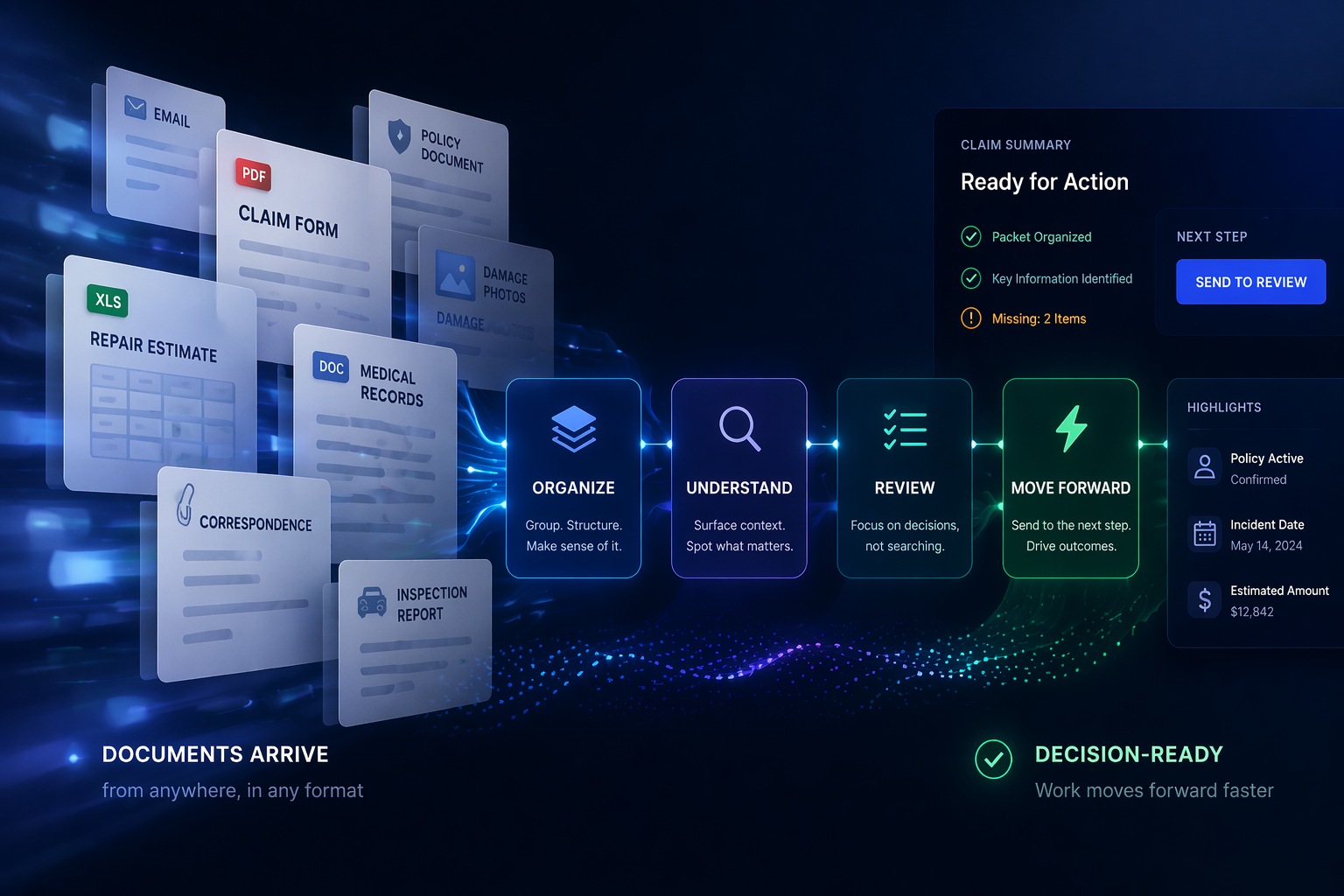
Documents arrive in fragments, supporting materials are spread across systems, reviewers rebuild context manually, and decisions stall between steps. Haystac is designed for that gap: not just reading documents, but helping teams use them to move work forward.
Less time figuring out the documents. More time moving the work forward.
These are the kinds of workflows where teams already have systems in place—but still lose time because documents remain hard to organize, hard to interpret, and hard to move through the business.
Organize claim packets, connect supporting materials, and surface the context reviewers need to reach a decision faster.
Group borrower documents, identify missing items, and help underwriting teams move faster with cleaner file context.
Ingest invoices and supporting records, surface exceptions, and reduce the manual effort involved in validation and approval.
Structure case files, identify key documents, and help teams review timelines, records, and supporting materials more efficiently.
Organize agreements and supporting documents, surface relevant sections, and help teams move through review cycles with less friction.
Bring together documentation, evidence, and supporting materials so analysts can spend less time searching and more time assessing.
Claims is one of the clearest examples of where Haystac adds value: multiple documents, supporting materials, handoffs between teams, and review cycles that stall because context has to be rebuilt manually.
Claims materials arrive from multiple sources—forms, attachments, photos, supporting records, correspondence, and prior documents. Before anything meaningful can happen, someone has to make sense of the file.
Haystac helps group, separate, and structure the incoming content so teams are not starting from a pile of disconnected files. The packet becomes easier to work with before reviewers spend time inside it.
Once the file is organized, Haystac helps surface what matters: what is present, what may be missing, which records support the claim, and where reviewers should focus first.
With cleaner context and fewer gaps in the file, reviewers can move more quickly to triage, exception handling, escalation, or adjudication. The workflow is still human-aware—but no longer slowed by preventable document friction.
The result is not just a better organized file. It is a workflow that reaches the next step faster—whether that next step is review, escalation, payment, investigation, or follow-up.
Claims materials arrive from multiple sources and often lack the structure teams need to move quickly.
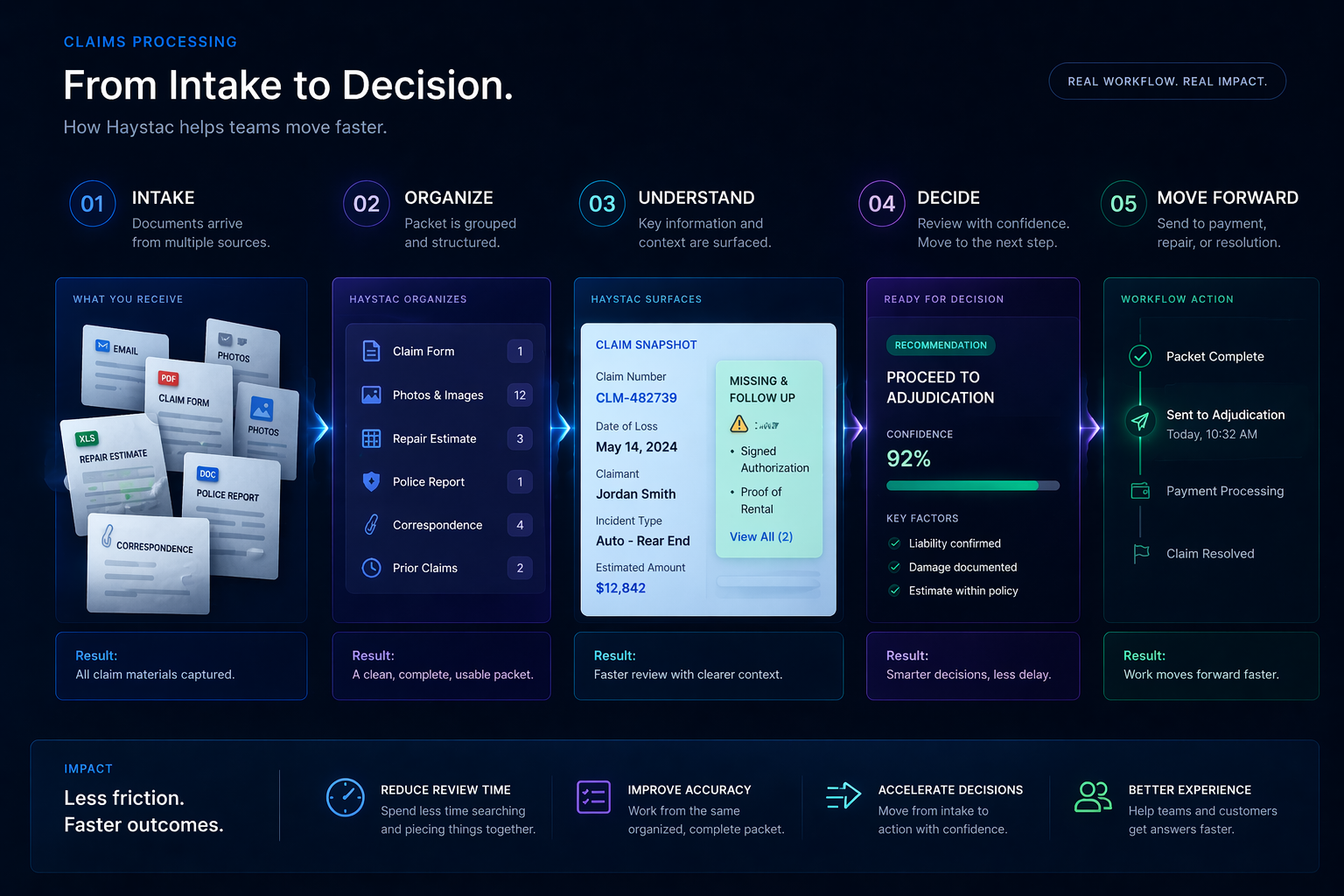
Haystac does not just help teams read a claim file. It helps them make progress through the work around it.
The value shows up not in a single extracted field, but in how the workflow behaves once teams stop spending so much time reconstructing the file.
Haystac is not meant to force a rip-and-replace decision. It is meant to strengthen the layer where document-heavy work still slows down—after intake has started and before the workflow has cleanly moved forward.
Fits beside current intake, workflow, and document-processing environments rather than requiring a complete restart.
Built for workflows where review, judgment, and governance still matter at critical points in the process.
Strengthens the handoff between document intake, understanding, review, and next-step action.
Aligned to the operational realities of organizations that care about security, control, and practical deployment fit.
Haystac does not replace your document processing or workflow tools. It improves the layer where work slows down after the document has already been processed.
Every organization handles document-heavy work differently. The fastest way to understand the value is to walk through your workflow and identify where time is still being lost between intake, review, and action.